
Dwight D. Eisenhower was the United State’s thirty-fourth President. In August of 1954, as a response to Cold War tensions, he requested special appropriations in “cultural and artistic fields” from the Senate (Von Eshen, 4).
 The United States government sent jazz musicians overseas as a form of cultural diplomacy. Dave Brubeck, a jazz pianist, and his band were sent to Poland, Turkey, East and West Pakistan, Afghanistan, India, Ceylon, Iran and Iraq (Gioia).
The musicians were meant to show the rest of the world that the United States was a democratic nation that embraced different races. However, this message was counteracted by the blatant examples of racial inequality in American society.

Dizzy Gillespie, a popular jazz trumpeter, was Eisenhower’s first “jazz ambassador.” Though hired to be a symbol of the United States, Gillespie was not willing to ignore his personal convictions regarding racism in America. After avoiding an official State Department briefing, he stated, “I’ve got three hundred years of briefing. I know what they’ve done to us and I’m going to make any excuses” (Von Eshen, 34).

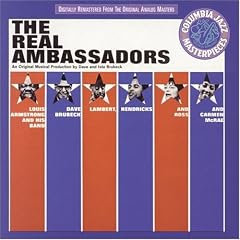
In 1960, after returning from their overseas tour Dave Brubeck and his wife Iola wrote “The Real Ambassadors,” a musical commentary on race relations in the United States based around their experiences as cultural ambassadors for the State Department. The score was performed only once, at the 1962 Monterey Jazz Festival, by Brubeck, Louis Armstrong and the cast of the recorded album where it received rave reviews (“The Real Ambassadors”). However, it was decided that such a show could not be unleashed on the racially charged United States at that time.
Bibliography
Gioia, Dana. “Dana Gioia Interviews Dave Brubeck on Cultural Diplomacy.” National Endowment for the Arts, (2006), http://www.nea.gov/about/NEARTS/11-2006vol2/11jazz4.html, (accessed March 1, 2008).
“The Real Ambassadors.” http://therealambassadors.com, (accessed March 1, 2008).
Von Eschen, Penny M. Satchmo Blows Up the World. (Cambridge: President and Fellows of Harvard College), 2004.
Photographs
“Colored Entrance of Movie House.” American Memory Collection. Library of Congress. http://memory.loc.gov/ammem/today/may18.html. (accessed March 1, 2008
“Dave Brubeck and Band.” National Endowment for the Arts. http://www.nea.gov/about/NEARTS/11-2006vol2/11jazz4.html. (accessed March 1, 2008).
“Dizzy Gillespie.” America’s Story. Library of Congress. http://www.americaslibrary.gov/jb/modern/jb_modern_dizzy_2_e.html. (accessed March 1, 2008).
“Dwight D. Eisenhower.” The President’s Council on Physical Fitness and Sports. Department of Health and Human Services. http://www.fitness.gov/50thanniversary/photos-firstfiftyyears/DwightDEisenhower-circa1956.jpg. (accessed March 1, 2008).
“The Real Ambassadors.” http://ecx.images-amazon.com/images/I/51HVKGW9V2L._AA240_.jpg. (accessed March 1, 2008).

 The
The 


No comments:
Post a Comment