Tuesday, March 4, 2008

Photo Essay Reaction

This project was very interesting. I chose to focus on a topic that I had a limited knowledge on. The subject of jazz musicians being sent abroad as ambassadors was discussed in a foreign policy class I took, as well as a class on American Popular Culture.


Finding photographs for this essay was not that simple, though I knew immediately what I wanted the essay to be comprised of. However, obtaining photographs that illustrated the points I wanted to make was difficult. First of all, I tried to get most of my photographs from government websites, so as to try and avoid copyright issues. The majority of the government websites that I researched had very little, if any, photographs of jazz musicians overseas. The photographs of President Eisenhower and that which I used to illustrate segregation in the United States were the easiest to find.


I ended up doing a google search for the musicians and got a very large amount of hits. From there I limited to the search to apply only to government websites. This severely limited my options. The photograph of Dave Brubeck and his band was found within an article on the National Endowment for the Arts website, and that of Dizzy Gillespie was on the America’s Story section of the Library of Congress website. I had hoped to get a photograph of Louis Armstrong as well, as he was one of the more famous jazz ambassadors. However, with the limit of five pictures, I decided to go with those that gave the most complete picture of the jazz ambassadors’ experiences, so Louis Armstrong had to be cut out.


All in all, I really enjoyed this assignment. It took me awhile to find each of the photographs, but I learned more about the topic as I was searching for them. After creating this essay I am more interested in reading about the experiences of the jazz musicians overseas during the Cold War.

Saturday, March 1, 2008

Cultural Diplomacy: The Jazz Ambassadors

Dwight D. Eisenhower was the United State’s thirty-fourth President. In August of 1954, as a response to Cold War tensions, he requested special appropriations in “cultural and artistic fields” from the Senate (Von Eshen, 4).

The United States government sent jazz musicians overseas as a form of cultural diplomacy. Dave Brubeck, a jazz pianist, and his band were sent to Poland, Turkey, East and West Pakistan, Afghanistan, India, Ceylon, Iran and Iraq (Gioia).


The musicians were meant to show the rest of the world that the United States was a democratic nation that embraced different races. However, this message was counteracted by the blatant examples of racial inequality in American society.


Dizzy Gillespie, a popular jazz trumpeter, was Eisenhower’s first “jazz ambassador.” Though hired to be a symbol of the United States, Gillespie was not willing to ignore his personal convictions regarding racism in America. After avoiding an official State Department briefing, he stated, “I’ve got three hundred years of briefing. I know what they’ve done to us and I’m going to make any excuses” (Von Eshen, 34).


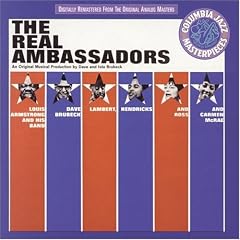
In 1960, after returning from their overseas tour Dave Brubeck and his wife Iola wrote “The Real Ambassadors,” a musical commentary on race relations in the United States based around their experiences as cultural ambassadors for the State Department. The score was performed only once, at the 1962 Monterey Jazz Festival, by Brubeck, Louis Armstrong and the cast of the recorded album where it received rave reviews (“The Real Ambassadors”). However, it was decided that such a show could not be unleashed on the racially charged United States at that time.


Bibliography

Gioia, Dana. “Dana Gioia Interviews Dave Brubeck on Cultural Diplomacy.” National Endowment for the Arts, (2006), http://www.nea.gov/about/NEARTS/11-2006vol2/11jazz4.html, (accessed March 1, 2008).

“The Real Ambassadors.” http://therealambassadors.com, (accessed March 1, 2008).

Von Eschen, Penny M. Satchmo Blows Up the World. (Cambridge: President and Fellows of Harvard College), 2004.


Photographs

“Colored Entrance of Movie House.” American Memory Collection. Library of Congress. http://memory.loc.gov/ammem/today/may18.html. (accessed March 1, 2008

“Dave Brubeck and Band.” National Endowment for the Arts. http://www.nea.gov/about/NEARTS/11-2006vol2/11jazz4.html. (accessed March 1, 2008).

“Dizzy Gillespie.” America’s Story. Library of Congress. http://www.americaslibrary.gov/jb/modern/jb_modern_dizzy_2_e.html. (accessed March 1, 2008).

“Dwight D. Eisenhower.” The President’s Council on Physical Fitness and Sports. Department of Health and Human Services. http://www.fitness.gov/50thanniversary/photos-firstfiftyyears/DwightDEisenhower-circa1956.jpg. (accessed March 1, 2008).

“The Real Ambassadors.” http://ecx.images-amazon.com/images/I/51HVKGW9V2L._AA240_.jpg. (accessed March 1, 2008).

Sunday, February 17, 2008

Valentine's Day

Part I

Every February people go out to purchase cards, candy and flowers. These gifts are given as tokens of affection to loved ones on the 14th of February, Valentine’s Day. This holiday is celebrated in many areas of the world, each country with their own traditions. However, it is difficult to obtain a single story which explains how this holiday came about in the first place. There are many stories surrounding the origins of Valentine’s Day, and the saint for which the day is named.

One legend asserts that Valentine was a priest who performed marriages in secret. This was done in opposition to Emperor Claudius II, who had decreed that young men shall not be married because single men were better soldiers. When his actions were discovered, Valentine was put to death. Another version of Valentine’s story is that he was executed after helping Christians escape Roman prisons. Others say that Valentine was put to death for love of his faith, refusing to renounce his religion. A fourth legend of Valentine had him sending the first "valentine" from prison to his love, the jailer’s daughter. There is no concrete evidence as to what the real story of Valentine is, but in each tale the man died at the hands of the Roman government, making him a romantic figure.

The celebration of Valentine’s Day has ties to both Christianity and Roman paganism. There are three St. Valentines honored in the Catholic Church, however it is unknown which of these men the Church had planned to celebrate on February 14th. Of the three men, one was a priest in Rome, one a bishop in Terni and the third died in Africa. The particularly interesting link between these men, other than their names, was that they are all said to have been martyred on February 14th.

Looking at the celebration from an ancient Roman perspective, February 14th coincides with the pagan festival of Lupercalia. This was a festival to celebrate purification and fertility. A dog and a goat would be sacrificed, after which young men would take strips of goat hide and run through the town. With the goat hide , they would lightly strike women, an act that was welcomed as it was believed to erase bad luck and infertility. In later years, a lottery was implemented in which young men would draw the names of available young women and the couples would be paired for at least the duration of the festival. It is thought that the Catholic Church decided to celebrate St. Valentine on the 14th of February in an attempt to make the transition from paganism to Christianity less turbulent. There are a number of examples of Christian holidays which coincide with ancient Roman festivals.

Modern celebrations of Valentine’s Day still have links to Roman paganism. One of the most common symbols associated with Valentine’s Day is that of Cupid, a mischievous child who shoots people with arrows which cause them to fall in love. Cupid is a being that has roots in both Greek and Roman mythology. In Greece he was known as Eros, the son of the goddess of love, Aphrodite, while in Rome he was Cupid, son of Venus.

Valentine’s Day has a complex history that is grounded in a number of cultures. However, despite this complexity, it has become a widely recognized day on which one is supposed to express their affection for others. Regardless of one’s belief system, Valentine’s Day is now seen as a holiday that is meant to celebrate love, particularly romantic love.

Part II

This was a very interesting paper to write. Finding information on Valentine’s Day was tricky, though not because there are not enough sites which dedicate space to discussing the holiday. The trick was to ascertain which site had reliable information, with some evidence backing it up.

I began by looking on the History Channel’s website. I felt that this was a site known to be reputable. It is well funded and created by people with a legitimate interest in history, rather than an unknown source whose knowledge can not be relied upon. Once reading their information on the history of Valentine’s Day, I began looking at other sites. From here, I tried to find sites which had similar facts. There were many different interpretations of the facts, but the sites I looked at had all the same main points.

I also stayed away from sites upon which anyone can editorialize. It seemed that it might be in the interest of the research to look at sites where there is just one main contributor. In the cases of those sites it seems that there is a greater chance that the information has been acquired through research, rather than a mix of information that a number of people have put together, some with knowledge of the subject and others without.

Even with the various methods I attempted to employ in finding information, the only site that I used that I felt I could really trust was that of the History Channel’s. I think this is only because I knew of it before hand. Also, it was clearly the most well funded of the sites which I looked at. The information garnered from this site seemed the most professional done. All in all, finding information for this essay was not nearly as difficult as deciding what information was valid.

Sunday, February 10, 2008

Clash of Cultures

Clash of Cultures looks at different aspects of America during the 1910s and 1920s. The website opens to a gateway page displaying four photographs fading into one another. Each of the pictures has a title ascribed to it; “The Scopes Trial,” “Prohibition,” “The New Woman,” and “Anti-Immigration & the KKK.” Clicking on any of these pictures will bring the viewer into that section of the website. There is also a menu of links on the bottom of the page that lead into the site.

The introduction to the site provides a page of general information on the two decades. There is a small chart discussing “old” culture and “new” culture, while the text gives some of the points that the other sections will be discussing. The gateway page and the introduction are both presented on a gray backdrop with maroon detailing. The pictures within the pages are black and white. It is very uniform and neat.

Once entering the “Prohibition” section the color scheme changes slightly, to a light blue backdrop with maroon detailing. This section is divided into six pages discussing the beginning of Prohibition, the reasons behind it and its effects. Links are provided to get more detailed descriptions of certain factors, such as arguments for and against prohibition. The pages all have a number of photographs and political cartoons to illustrate the point of the section.

“Immigration Restriction & the Ku Klux Klan,” is presented on a light pink background with maroon detailing. The opening page has a small paragraph of introduction. There are two pictures on the bottom of the page, each leading to a different section, either “Immigration Restriction,” or “Ku Klux Klan.” Each section is three pages long illustrated with photographs and political cartoon, with links leading to pages of greater description of certain topics.

“The New Woman,” is presented in the same color scheme as “Immigration Restriction & the Ku Klux Klan.” There is a page of introduction under a collage of photographs and drawings, in both black and white and color. Each picture has a title ascribed to it that will bring the viewer to a different page within the section. None of the sections within “The New Woman” are more than two pages.

“The Scopes Trial” is a four page section presented on a light lavender background with maroon detailing. Within the text there are links to the conflicting schools of thought of fundamentalism and science. This section also discusses other trials that were going on at the time and how the Scopes trial fit in to the times.

There is a menu on the upper left side of each page, where one can click on an index of the section, rather than going through each page. There are also links to other websites dealing with the topic and a page of books for further reading. If the viewer is looking for secondary source material, the further reading lists are very helpful. However, if one wants to find primary material then the links within the sections provide the most information. There is also a link on the bottom of the menu that leads to a website upon which you can purchase Retrieving the American Past, a book meant to help people create their own history readers.

This site is very easy to navigate, the photographs are very clearly marked, and the side menu is present on every page for the ease of the viewer. The presentation of the site is simple, but effective. The background coloring is in pastel tones, with the maroon detailing the boldest color choice. Photographs are present in every section, but they do not overpower the text. They fit nicely into the flow of the pages. The use of political cartoons is particularly effective because they present an idea as to how people of the time were viewing the different issues in a way that photographs cannot. The often satirical nature of the cartoons does a good job of showing the people and opinions on the different sides of the topic.

There is a good deal of content in the pages of the site. A good background is given on each topic, while the links lead to more specific arguments dealing with the subject. Clash of Cultures is good for both people who are new to the subject matter and those who already have a familiarity. For those who already know information on these issues, the links and suggestions for further reading might be the most helpful in discovering new scholarship.

Monday, January 28, 2008

Different Approaches

There are many websites that are dedicated to historical studies. Each website comes at the subject in a different manner providing those surfing the internet with a number of options when they are doing their studies and research. The problem that some of these websites deal with is that, without having some section of new information on daily or weekly basis, people may not revisit the site often. One way of dealing with this is to angle the website to a specific audience.

The Valley of the Shadow: Two Communities in the American Civil War (http://valley.vcdh.virginia.edu/) looks at northern and southern community in the United States from 1859 to 1870. Once entering the website the visitor is allowed to choose from different sections in different time periods (http://valley.vcdh.virginia.edu/choosepart.html). Within most sections the visitor is also give the option to search for specific documents rather than browse. There is a great deal of primary source material to be found on this site. The documents range from newspaper articles to government and religious records to letters and diaries. The website seems to be angled towards an audience of researchers.

There are no sections that provide new information on a daily or weekly basis. This could cut down on the number of times a person might revisit the site, despite the wealth of information that is provided within the different sections. While it does lack this daily pull of some other websites, it is very streamlined and easy to follow. There is a great deal of information to be found using the “Valley Project.” It gives varied perspectives, broken up geographically, on a turbulent time period in the country’s history.

The History Channel (http://www.history.com/) takes an interesting approach to history on the internet. They address the issue of providing new information each day with a “Quick Poll” and a section called “History Now,” which deals with events that are happening every day, such as the President’s State of the Union address. This article discusses President Bush’s agenda during his last year as President and offers links to videos of past Presidents giving the State of the Union address (http://www.history.com/minisite.do?content_type=mini_home&mini _id=57351). There is also a discussion board where people can converse over topics in history and the present day. Each of these features provides new information each day which will keep people coming back.

On the homepage, the website gives a schedule of programs that will be shown on the History Channel, as well as a list of the most watched videos and most popular forums. Through these forums the website works to form a community of its viewers, therefore ensuring that they are likely to come back. A visitor to the site can search for any historical event, as well as looking at today in history. This website provides a multi-media perspective on history, while also spotlighting the fact that history is unfolding around people every day.

Do History (http://dohistory.org/) looks at the diary of Martha Ballard and discusses how one would piece together history using such resources. At the very top of the home page is a link to a description of what the site is meant for (http://dohistory.org/about/site.html). The site is made for those who wish to pursue projects in history and would like to learn different methods of creating a narrative of the past using what materials have survived. The website provides a good deal of information on Martha Ballard, a midwife, including primary sources, excerpts from the book based on Ballard’s diary and clips from the movie based on the book.

There is a link on the homepage to a couple of interactive features to help the visitor gain a better understanding of how to work with the information presented to him (http://dohistory.org/DHindex.html). While this website does not provide new information each day for the viewer, it is a good resource for figuring out how to fill in the blanks of history. The final link on the homepage is to a section containing links to other websites, in addition to “how-to” essays on historical research (http://dohistory.org/on_your_own/index.html). This website, like The Valley of the Shadow, is primarily useful for researchers.

The primary purpose of the National Museum of American History website (http://americanhistory.si.edu/index.cfm) is to draw people to the museum. They use a number of graphics to give a quick showcasing to the objects that are on display in the museum. On the homepage there is a section on collections that has a photo of an object that changes every couple seconds. The objects range from locomotives to Kermit the Frog to an old top hat. Once clicking on that tab the visitor is brought to a page detailing the many collection subjects that can be found at the museum.

There is an area discussing the renovations that are currently going on at the museum, as well as a link to the exhibit of National Museum of American History objects that are on display at the Air & Space Museum. To the bottom left-hand corner of the homepage there are links to museum news and events that will be occurring in the near future. This information changes every few days which could provide a draw for people to return to the website even though the museum is currently closed.

Each of these websites comes at history from a different angle, from research to commercial. They all provide a good deal of information while approaching topics in a varied manner. The History Channel and the American Museum of American History span long time periods while The Valley of the Shadow looks at an eleven year period and Do History focuses on one person. The two websites which look at history in a broader sense seem to target the general public while the narrower view is ideal for researchers.

Monday, January 21, 2008

Blog Review

http://blog.foreignpolicy.com/ is part of Foreign Policy Magazine. This blog is updated Monday thru Friday by a number of different contributors. There are anywhere between five and twelve posts a day about different aspects of foreign policy throughout the globe. The audience for this blog is people who have an interest in foreign policy. The way the posts are written indicate that the audience is assumed to have some previous knowledge of the topic. However, they do make the information accessible to those who do not already know about the events which are being written about through the links included in the posts. There are links to stories in American publications, such as Foreign Policy Magazine, New York Times and The Washington Post, as well as to articles in European publications such as Britain’s Telegraph.

This blog provides a good deal of information on a number of topics. Many posts deal with some aspect of American foreign policy, but some deal solely with events happening in other countries. Some of the posts are lengthy discussions of topics, such as the morning brief, which goes into events in Asia, the Middle East, Europe, “Elsewhere,” 2008 U.S. Election, and the day’s agenda. Other posts are short responses events pertaining to foreign policy, such as a boy scout stopping an assassination attempt on the president of the Maldives, Maumoom Abdul Gayoom[1], and reactions to Freedom House’s 2008 Freedom in the World Report.[2] There are also posts written that review books that all the posters are reading.[3] Each book can be related back to a certain aspect of foreign policy.

While the blog does deal with a number of important topics that affect the global landscape, there are also posts that give a witty look at such matters as the origins of fortune cookies.[4] After discussing that the fortune cookie has roots in Japan, it is stated, “The funny thing is, in discussion of the inter-Asian rivalry, many Chinese often complain that elements of Japanese and Korean culture actually stem from China, if you go back far enough. Now we’ve got a modern Chinese-American food that actually stems from Japan.” Even these posts are related back to some aspect of a world issue.

The blog is easy to follow with the most recent posts at the top. Each post is separated by a by a bolded title in a different color from the rest of the text. Many of the posts included photographs to supplement the event that the author is responding to. The occasional post is simply a small reaction to a photograph, as in the case of a post from Monday, January 14th which responds to a picture of President Bush and the King of Saudi Arabia greeting each other.[5]

The posts are well written responses to world events. For certain posts the prose is a formal reporting on an issue, while others are more informal, satirical reactions to global matters. The blog provides a lot of information on a variety of topics while being interesting and entertaining to read.


[1] “Boy Scout Foils Dastardly Plot.” Weblog Entry. Foreign Policy Passport. 14 January 2008. .

[2] “The World Is a Little Less Free.” Weblog Entry. Foreign Policy Passport. 16 January 2008. .

[3] “What We’re Reading.” Weblog Entry. Foreign Policy Passport. 14 January 2008. .

[4] “Fortune Cookies are from Japan?” Weblog Entry. Foreign Policy Passport. 16 January 2008. .

[5] “He Kisses For Thee.” Weblog Entry. Foreign Policy Passport. 14 January 2008. .